ALFA

Alfa (huruf : Α, α) is the first Greek alphabet.

NIO

Derived from the Latin Language Neo means New

ALFANIO

My last name from my parents. Literally A New One.
 

Synthetic Oil or Mineral Oil? Which one is better?

Thursday, April 21, 2011

Motor or Car Engine Oil


The answer is not as simple as “yes” or “no”. A better question would be:
“Is synthetic oil the best choice for this application? All types of synthetic base oils can be the best choice for certain situations.” That will help you to identifying some situations where they make sense or provide value.

Synthetic Oil
There are plenty of potential benefits to using synthetic oil vs mineral oil, but that doesn’t mean that synthetics are necessarily better. 


Mineral Oil

In order to get value from using a higher-priced synthetic oil, you must ensure that you are utilizing the potential improved performance of those products; and to make those determinations, you need to understand the conditions that allow synthetics to provide that value. To more fully understand this issue, first consider the major advantages of common types of synthetic base oils and then identify the conditions for which these advantages become benefits.

For the sake of brevity, I will not discuss all synthetics, but rather focus on the most common ones –  
PAOs (polyalphaolefins), PAGs (polyalkaline glycol), diester and polyol ester.

Polyalphaolefins (PAOs)
PAOs, often called synthetic hydrocarbons, are probably the most common type of synthetic base oil used today. They are moderately priced, provide excellent performance and have few negative attributes.

PAO base oil is actually similar to mineral oil. The advantage comes from the fact that it is built, rather than extracted and modified, making it more pure. Practically all of the oil molecules are the same shape and size and are completely saturated.

The potential benefits of PAOs are improved oxidative and thermal stability, excellent demulsibility and hydrolytic stability, a high VI, and very low pour point. Most of the properties make PAOs a good selection for temperature extremes – both high operating temperatures and low start-up temperatures. In my opinion, those are the conditions that favor PAO selection. Typical applications for PAOs are engine oils, gear oils and compressor oils.

The negative attributes of PAOs are the price and poor solubility. The low inherent solubility of PAOs creates problems for formulators when it comes to dissolving additives. Likewise, PAOs cannot suspend potential varnish-forming degradation by-products, although they are less prone to create such material.

For the most part, this issue of solubility can be addressed through the addition of other base oils such as diester. The cost issue is really about whether or not you actually get value by utilizing the performance.

Polyalkaline glycols (PAGs or PGs)
PAG base oils have several unique properties that allow them to work very well in certain applications. In general, they have excellent oxidative and thermal stability, very high VI, excellent film strength and an extremely low tendency to leave deposits on machine surfaces. The low deposit-forming tendency is really due to two properties – the oil’s ability to dissolve deposits and the fact that the oil burns clean. So when they are exposed to a very hot surface or subjected to micro-dieseling by entrained air, PAGs are less likely to leave residue that will form deposits. PAGs may also be the only type of base oil with significantly lower fluid friction, which may allow for energy savings. The other unique property of PAGs is the ability to absorb a great deal of water and maintain lubricity.

There are actually two different types of PAGs – one demulisifies and the other absorbs water. The latter can be very useful if you have a compressor that cannot be stopped that is continually contaminated with large amounts of water. The most common applications for PAGs are compressors and critical gearing applications.

The negatives of PAGs are their very high cost and the potential to be somewhat hydrolytically unstable.

Dibasic Acid Ester (Diester)
The properties of diester are somewhat similar to that of PGs. It has excellent oxidative and thermal stability, very high VI and excellent solubility. This excellent solubility makes it a good choice for reciprocating compressors, where valve deposits can be a huge problem. Another common application for diester is in synthetic engine oil. It is often used as an additive with PAO basestocks to provide the necessary solvency for the engine oil’s large additive package. As a side effect, the synthetic engine oil will have excellent detergency. The negative attributes of diester are the high price and poor hydrolytic stability.

Polyol Ester
Polyol ester basestocks have several excellent performance properties, including thermal stability, super-high VI and fire resistance. Of the base oils mentioned in this column, it is probably the best choice for very high-temperature applications. The two most common applications for polyol ester are fire-resistant hydraulic fluids and jet engine oils. They can be used in engine oils and compressor applications, as well. The negative attributes are the same as those for diester.

3 Common Misconceptions about Synthetic Oil
There are at least three common misconceptions about synthetic oil. The first misconception is that a car has to be flushed before using synthetic oil. The second misconception is that motorcycles do not benefit from using synthetic oil. The third misconception about synthetic oil is that your car's warranty will be voided if you use synthetic oil. These misconceptions are founded in a belief that synthetic oil is bad for cars and that you should use conventional oil only.  

There are other misconceptions associated with the use of synthetic oil. You can find these misconceptions published by the makers of synthetic oil. You can go on line for the specifics or contact the manufacturer of the synthetic oil.

1. A Car Needs to Be Flushed
There is a misconception that the car needs to be flushed completely of its conventional oil before you can add synthetic oil. The fact is there is no special preparation that is required when you add synthetic oil to your car. switching to synthetic oil only requires you to start adding it to your engine. The next time you have an oil change ask that synthetic be added completely.

Flushing the car's oil is only necessary if you are experiencing problems with the engine. This includes sludge build up and problems with starting and stopping the engine. An engine flush will solve these problems and you can take the opportunity to substitute your old conventional oil with synthetic oil. 

2. Motorcycles cannot Use Synthetic Oil
Another common misconception about synthetic oil is that motorcycles do not benefit from its use. The fact is that synthetic oil is especially designed for motorcycles and motorcycle use. Many synthetic oil companies make products that are specially designed for motorcycles.

A motorcycle's engine design is best suited for using synthetic oil. A motorcycle high performance makes it the ideal vehicle for using synthetic oil. 

3. Car's Warranty will be Voided
A third misconception about synthetic oil is that the car's warranty will be voided if you use synthetic oil. This is not true with the exception of Mazda brand cars. Mazda brand cars do not permit the use of synthetic oil and any such use will immediately void the car's warranty. No other vehicle brand has such as restriction regarding the use of synthetic oil nor do they have such a prohibition in place. As such using synthetic oil in place of conventional motor oil does not pose any problems for you as long as the vehicle that you own is not a Mazda brand car.

These are a few of the common misconceptions associated with synthetic oil. Other misconceptions can be found online. Any questions that you have regarding the use of synthetic oil should be raised with the manufacturer of the oil or the manufacturer of your car. This is the best source to determine how to use synthetic oil.

Go for ‘Right’ Quality
There are many applications for which synthetic oils provide solutions to tough operating conditions. I have mentioned a few of those here, but there are others. To me, it is not so important to use the “best” quality lubricant in every application, but rather to use the “right” quality.


Synthetic oil is improvement from mineral oil, and that will caused overall synthetic oil better than mineral oil. Synthetic oil has uniform molecular structure and perfectly balance.

The Uniform of molecular structure from the oil


Many people waste money on expensive products that for a number of reasons don’t improve reliability or anything else. One other important thing to remember is that I am discussing the properties of base oils, not finished lubricants. It is quite possible for a finished lubricant using a mineral basestock to offer better performance than a similar product utilizing a synthetic.

So, back to the original question, is synthetic oil better? The answer is yes … and no … or maybe. You’ll have to decide.
Read more...

Active Ingredients in Body Care (part 1)

Tuesday, March 1, 2011


We are familiar in of these product or brand:

  • Soap (White Dove® Beauty Bar Soap for Deep Moisture);
  • Lotion (Vaseline® Intensive Care Total Moisture);
  • Shampoo ( Clear ® for Men Anti Dandruff);
  • Face Wash Soap (Vaseline ® Men Whitening Face Wash).
In this post, I will tell you several active ingredients of that product. I pick that product because I use it for my daily care, but I did not use Dove ® soap. I use general bar soap, because I think using lotion is enough to take care of my skin. 


Beauty Soap (White Dove® Beauty Bar Soap for Deep Moisture)

Dove ®

Everybody know this White Dove® Beauty Bar Soap for Deep Moisture is one of best beauty soap because its contain ¼ part of moisturizer. This moisturizer makes our skin does not dry anymore. Our skin will see healthy and not dry (even some other people feel scaly in their skin). White Dove® Beauty Bar Soap represent for the costumer very well.
In chemical engineering, this moisturizer known as a hygroscopic chemical compound. However, this chemical compound is harmless for human skin. It does not make allergic (but maybe it can affect several people). This hygroscopic chemical compound can absorb water in air. For the result is our skin, which is been take care by moisturizer; will not dry because of the hygroscopic chemical compound will “Moist” of our skin.
                Ingredients of White Dove® Beauty Bar Soap for Deep Moisture is:
·         Sodium Cocoyl Isethionate,
·         Stearic Acid,
·         Coconut Acid,
·         Sodium Tallowate,
·         Water,
·         Sodium Isethionate,
·         Sodium Stearate,
·         Cocamidopropyl Betaine,
·         Sodium Cocoate,
·         Palm Kernelate,
·         Fragrance,
·         Sodium Chloride,
·         Tetrasodium EDTA,
·         Trisodium Etidronate,
·         BHT,
·         Titanium Dioxide (CI 77891),
·         Sodium Dodecylbenzene Sulfonate.

BHT:
Butylated hydroxytoluene (BHT) is a toluene-based ingredient used as a preservative in food and personal care products.
TITANIUM DIOXIDE:
Titanium dioxide is an inorganic compound used in a range of body care products such as sunscreens and makeup. It appears to have low skin penetration but inhalation is a concern.
COCAMIDOPROPYL BETAINE:
Cocamidopropyl betaine is a synthetic surfactant; it has been associated with irritation and allergic contact dermatitis, reactions that could be due to the ingredient itself or to impurities present in it, such as 3-dimethylaminopropylamine.

Beauty Lotion (Vaseline® Intensive Care Total Moisture)

Vaseline ®

Vaseline brand is one of best lotion because of the experience of the company for many years serve the customer very well. Same as point 1 (Dove®), this lotion also contain moisturizer that makes our skin does not dry anymore. Our skin will see healthy and not dry (even some other people feel scaly in their skin).
This moisturizer known as a hygroscopic chemical compound. However, this chemical compound is harmless for human skin. It does not make allergic (but maybe it can affect several people). This hygroscopic chemical compound can absorb water in air. For the result is our skin, which is been take care by moisturizer; will not dry because of the hygroscopic chemical compound will “Moist” of our skin.
                Ingredients of Vaseline® Intensive Care Total Moisture is:
·         WATER,
·         GLYCERIN,
·         STEARIC ACID,
·         GLYCOL STEARATE,
·         PETROLATUM,
·         ISOPROPYL PALMITATE,
·         GLYCINE SOJA STEROL (SOYBEAN),
·         HELIANTHUS ANNUUS SEED OIL (SUNFLOWER),
·         OR GLYCINE SOJA OIL (SOYBEAN),
·         AVENA SATIVA KERNEL PROTEIN (OAT),
·         SODIUM STEAROYL 2 LACTYLATE,
·         TOCOPHERYL ACETATE (VITAMIN E ACETATE),
·         RETINYL PALMITATE (VITAMIN A PALMITATE),
·         CARBOMER,
·         LECITHIN,
·         KERATIN,
·         DIMETHICONE,
·         GLYCERYL STEARATE,
·         CETYL ALCOHOL,
·         SODIUM PCA,
·         POTASSIUM LACTATE,
·         LACTIC ACID,
·         COLLAGEN AMINO ACIDS,
·         MINERAL WATER,
·         FRAGRANCE,
·         TRIETHANOLAMINE,
·         MAGNESIUM ALUMINUM SILICATE,
·         UREA,
·         METHYLPARABEN,
·         DMDM HYDANTOIN,
·         IODOPROPYNYL BUTYLCARBAMATE,
·         DISODIUM EDTA,
·         TITANIUM DIOXIDE (CI 77891).

DMDM Hydantoin :
DMDM hydantoin is an antimicrobial formaldehyde releaser preservative. People exposed to such formaldehyde-releasing ingredients may develop a formaldehyde allergy or an allergy to the ingredient itself and its decomposition products. In the U.S., approximately 20% of cosmetics and personal care products contain a formaldehyde-releaser and the frequency of contact allergy to these ingredients is much higher among Americans compared to studies in Europe.
Iodopropynyl Butylcarbamate:
Iodopropynyl butylcarbamate is used as a preservative in cosmetic formulations; it is acutely toxic by inhalation and should not be used in products that can be aerosolized or inhaled.
Lecithin:
Lecithin is a naturally ocurring lipid found in both plants and animals. According to the PETA's Caring Consumer guide, lecithin for com mercial purposes is most commonly obtain from eggs and soybeans.
Magnesium Aluminum Silicate:
Magnesium Aluminum Silicate is a naturally occurring mineral derived from refined and purified clay that is used primarily as a thickener in cosmetics and beauty products. It is naturally of a flaky, white consistency and is used most often as filler in deodorants, shaving creams and thick lotions. It is also important to note that Magnesium Aluminum Silicate has unusually large molecules; because of these large molecules, it is unable to be absorbed into the skin.


Will be continued…

Read more...

Pheromon : Falling in Love (From Your Nose then Going Down to Your Heart)

Sunday, January 30, 2011

The bulk majority of human pheromones belong to a group of chemicals known as 16-androstenes.
Definition
The term pheromone - from the Greek roots of pherin, to transfer, and hormone, to excite - describes a class of chemicals that are communicated between animals of the same species and that elicit stereotyped behavioural or neuroendocrine responses. Some pheromones - called "releaser" pheromones - elicit an immediate response, while others - termed "primer" pheromones - induce long-term changes in behavioural or endocrine state.


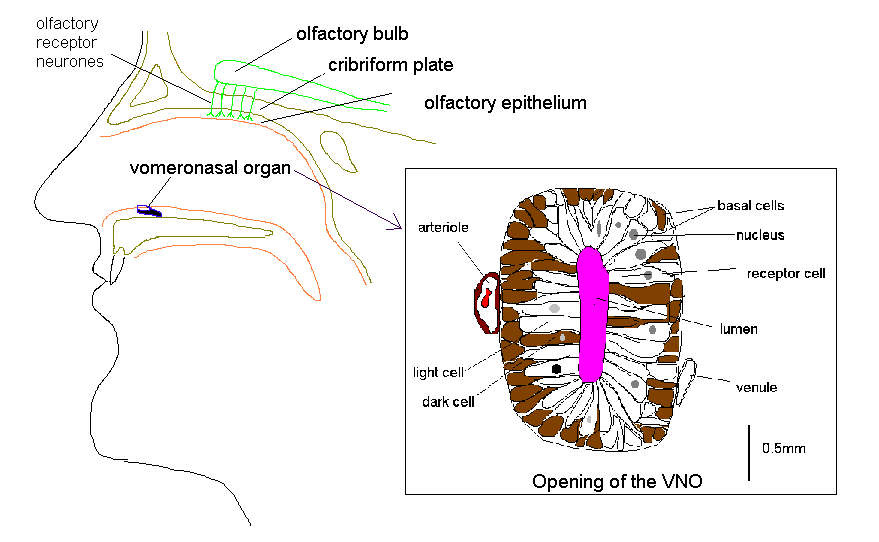
Pheromone-induced responses are mediated primarily by the vomeronasal organ (VNO). The VNO, also known as "Jacobson's organ", is part of an accessory olfactory system. It is present in a variety of non-human vertebrates but its existence in the human has been open to question until recently.


Historical Perspective
The VNO was first discovered by Ruysch (1703), a military doctor, in a soldier with a facial wound. The organ was named after Jacobson who published his findings on animals, but not humans, in 1811. Various other investigators have published studies; Potiquet (1891) observed the VNO in 25% of 200 adult humans, Pearlman (1934) described its occurrence in many animals, in human embryos and mentioned that it may be found occasionally in the adult human. (more detail can be found in Moran, Monti-Bloch, Stensaas and Berliner (1994)).

It was work published by Crosby and Humphrey (see below) that put the functional presence of the VNO in the human adult into doubt. In a standard anatomical textbook, "Correlative Anatomy of the Nervous System" by Crosby, Humphrey and Lauer (1962), we read the following; "In some human embryos, an accessory olfactory bulb, with complete representation of layering from the glomerular through the mitral cell layer, is to be found on the dorsomedial aspect of the main olfactory bulb (Humphrey, 1940). The accessory bulb receives the vomeronasal (or Jacobson's) nerve from the vestigial vomeronasal organ, which has also been demonstrated in the human embryo (McCotter, 1912). The vomeronasal nerve and its associated bulb vary in size and may be absent in the human embryo (Humphrey, 1940; Macchi, 1951). This variability appears to be characteristic of these structures in certain other adult primates (Lauer, 1945, 1949) Jacobson's organ and nerve and the accessory olfactory bulb are well developed in certain submammals and some subprimate mammals (Crosby and Humphrey, 1939). They are not present in adult man (Crosby and Humphrey, 1941). In human development these structures are merely ontogenetic signs of the persistence of phylogenetic structures and are without function".

Largely as a result of the above observations the existence of the VNO in humans has been disregarded. The consensus has been that, if it exists at all, it is vestigal and not functional. As recently as 1991 a paper by Meredith asserted that the accessory olfactory system is not present in humans or other old-world primates. This disregard for the existence of the VNO in adult humans is exemplified by the fact that the area containing the VNO is often removed during plastic surgery on the nose.

In 1980, Kreutzer and Jafek documented the early morphogenesis of the vomeronasal organ in the human embryo and early foetus. Later, in 1985, Johnson et al. examined 100 human adults specifically for the presence of the opening of the vomeronasal organ on the antero-interior part of the nasal septum. This was found in 39% of patients. Twenty seven human septums were removed post mortem, and vomeronasal structures were found in 70% of these. However, histological examination failed to reveal any evidence that these organs were functional (Johnson et al., 1985). In the same year, Nakashima et al. studied the VNO and nerves of Jacobson in a 28-week human foetus. They described the structure of the organ and traced the vomeronasal nervealong the nasal septum and through the cartilaginous cribriform plate with the olfactory nerve. While they found evidence for the existence of receptors in the vomeronasal epithelium similar to those in the olfactory epithelium, they suggested that the lack of intraepithelial blood vessels and mitotic figures in the epithelium indicated that the organ was undergoing degeneration at 28 weeks of gestation (Nakashima, Kimmelman and Snow, 1985). Since 1985 there has been a steady accumulation of evidence demonstrating the presence of the VNO in most, if not all, humans (Moran et al., 1985, 1991; Johnson et al., 1985; Stensaas et al., 1991; Garcia-Velasco and Mondragon, 1991, and reviewed in Moran et al., 1995).

The VNO is located bilaterally on the anterior third of the floor of the nasal septum. It opens into the nasal cavity by a pit which varies in size from 0.2 to 2 mm situated 1-2 cm from the posterior margin of the nostril. 

VNO Structure
The VNO is lined by a pseudostratified, columnar epithelium some 60um in depth that lies on a thick basement membrane. The vomeronasal neuroepithelium contains three morphologically distinct cell types; basal cells, dark cells and light cells. The basal cells are small, polygonal, dark-staining cells, measuring 6um in diameter. The dark cells are tall, slender, columnar cells with densely staining cytoplasm. The light cells are tall, columnar cells that, like the dark cells, extend from the basement membrane to the free surface of the epithelium. They differ from the surrounding cells of the respiratory epithelium in the nose by having no cilia (Moran et al, 1995).

VNO Receptors
The vomeronasal organ in the human foetus from 12 to 23 weeks is lined by a pseudostratified epithelium, with neurone-specific enolase (NSE) positive cells which resemble olfactory receptors. However, at 36 weeks the organ was lined by a respiratory epithelium and did not show any receptor-like cells, although there were some pear-shaped NSE-positive cells in the upper part of the respiratory epithelium of unknown significance (Boehm and Gasser, 1993). It was suggested that, during the early foetal period, the VNO could have some, as yet unknown, sensory function (op. cit.).

In contrast, calbindin, a 28Kd protein that has been immunolocalised to VNO receptor cells, was found to be expressed in humans, firstly in a male neonate and secondly an adult female suggesting the presence of receptors during early development and in the adult (Johnson, Eller and Jafek, 1994)

Whether or not the VNO continues to express receptor cells or neuronal markers in the adult, the structure itself continues to expand according to Smith et al. (1997). When comparing the increase in length of the VNO in the developing foetus to the length in the adult human, they concluded that further prenatal or postnatal size increase must occur.
 
VNO - Functionality
Compounds occurring naturally on the human skin were found to cause a local depolarisation when applied directly to the VNO (Monti-Bloch and Grosser, 1991). The nature of these compounds was not disclosed. This depolarisation had the characteristics of a receptor potential. Furthermore these compounds did not cause a response from the olfactory epithelium and, olfactory stimulants (e.g. cineole) had no effect on the VNO. Using the same compounds sexual dimorphism was demonstrated in their effect on electrodermal activity (Monti-Bloch et al, 1994). These compounds were subsequently revealed to be 16-androstenes and estrenes (Berliner, 1993; 1994). The androstenes have been previously isolated from human sweat (secreted by the axillary apocrine glands) (Gower et al., 1985).
Another "vomeropherin", pregna-4,20-diene-3,6-dione (PDD), caused evoked potentials in the VNO and also changed gonadotropin pulsatility in males, resulting in a reduced level of luteinizing hormone (Berliner et al, 1996) and testosterone (Monti-Bloch et al, 1998). In addition, PDD decreased respiratory frequency, increased cardiac frequency and caused event-related changes of electrodermal activity in EEG pattern (Berliner et al, 1996). 

Is The Adult Human VNO Vestigial?
The overwhelming anatomical evidence suggests that the in the adult human the VNO is vestigial (Meredith, 2001). There is no evidence for any anatomical connection from the VNO to the brain. Furthermore, the channel responsible for pheromone transduction in lower mammals, TRP2 (a non-selective cation channel), is a pseudogene in humans. However, this does not mean that human pheromones do not exist. mRNA for a vomeronasal receptor, hV1RL1, has been found in the human olfactory epithelium (Rodriguez & Mombaerts, 2002).

Human Pheromones
When pheromones were first discovered in the late 1950s they were defined as “..substances which are secreted to the outside by an individual and received by a second individual of the same species, in which they release a specific reaction, for example, a definite behaviour or a developmental process” (Karlson and Luscher, 1959).
Following the pioneering work on menstrual synchrony by McClintock (1971), Stern and McClintock (1998) have shown that odourless axillary compounds from the armpits of women in the late follicular phase of their menstrual cycles accelerated the preovulatory surge of luteinizing hormone of recipient women and shortened the menstrual cycles. Axillary compounds from the same donors which were collected later in the menstrual cycle (at ovulation) had the opposite effect: they delayed the luteinizing hormone surge of the recipients and lenghtened their menstrual cycle (Stern and McClintock, 1998).
The work by McClintock is very supportive of the existence of a chemical signal in axillary secretion - a pheromone - but it does not prove the existence of a functional VNO. 

Androstadienone
Androstadienone is the current best candidate we have for a human pheromone. Is is a component of human (in particular male) secretions. Does androstadienone meet Karlson & Luscher (1959) "pheromone" criteria? In human studies in which androstadienone had access to the olfactory mucosa both physiological and psychological effects have been reported (Jacob and McClintock, 2000; Jacob, Hayreh and McClintock, 2001; Jacob, Garcia, Hayreh and McClintock, 2002 Bensafi et al., 2003; Lundstrom et al., 2003; Bensafi et al 2004a, 2004b; Cornwell et al., 2004). While none of these changes can be regarded as the behavioural changes required for a compound to qualify as a pheromone, Savic et al. (2001) demonstrated that androstadienone activated the hypothalamus in a gender-specific manner (it activated the hypothalamus in women but not men). Compared with other odorous substances, androstadienone activated the anterior part of the inferior lateral prefrontal cortex (PFC) and the superior temporal cortex (STP) in addition to olfactory areas (Gulyas et al., 2004). The PFC and STP have been implicated in aspects of attention, visual perception and recognition and social cognition.

The definition of a pheromone (see above, Karlson and Luscher 1959) was later modified to include a mutual benefit requirement (Rutowski, 1981). In this context it is possible to see such mutual benefit if the pheromone leads, for example, to choice of partner on the basis of their HLA-dependent odortype to increase immune diversity (Ober et al., 1997, 1999) and lower miscarriage rates (Ober et al., 1998) or if the pheromone participates in the mother-infant bonding process (Schleidt, 1992). On its own it is unlikely to be able to achieve these outcomes but, as recently reported by Coureaud et al (2004), a pheromone can act as a reinforcing agent or a one-trial conditioning agent in which the presence of the pheromone converts a second odour (that of the partner or infant) into a conditioned stimulus.

Odor and Major Histocompatibility Complex
Mice can distinguish one another by odour. This odour is genetically determined and partly specified by the H-2 major histocompatibility complex (MHC) (Yamazaki et al, 1979; 1994) on chromosome 17 (Schellinck et al, 1993). There are however other genetic loci coding for odortypes found on the nonrecombining part of the Y chromosome (Schellinck et al, 1993). These odors are excreted in the urine and may play a part in pregnancy block (the Bruce effect), aggression and other mouse social behaviours.

The human equivalent of the MHC locus is the human leucocyte antigen (HLA). Numerous studies have been carried out with humans that suggest that axillary odour contains enough chemical differences in its odour profile to allow for discrimination between individuals. It has been hypothesised that at least some of this individual specific odour may be under the control of human leucocyte antigen (HLA) genes (Preti, Spielman and Wysocki, 1997). Studies have shown that women prefer those male odours that have HLA types different from their own - a preference that was reversed when those women doing the rating were taking oral contraceptives.
Supporting evidence for the existence of individual-specific odour comes from studies in which mothers have identified their own newborn infants from the smell of a previously worn T-shirt (Schaal et al, 1980). In turn, infants prefer breast or axillary pads from their own mothers, distinguishing the odour from other kin (Schaal et al, 1991).

Summary
Pheromones are well established in many species but the their existence in humans is still controversial. Much of the problem lies with the fact that the original definition of a pheromone cannot allow for volitional control over the biological response. Humans have a will of their own and can refuse the biological imperative. How then do you determine if a chemical signal is altering human behaviour? The experiments that have attempted to do this, e.g. by measuring autonomic responses, have had extremely variable results. The results in one lab are different to those in another. This implies that the are too many uncontrolled variables. Humans are obstinately different. They respond differently depending upon whether the experimenter is male or female for instance!
While the behavioral changes induced by axillary secretions are supportive evidence, they have not convinced everyone in the field - measuring menstrual synchrony is a process fraught with problems. Receptors (or at least their mRNA) for pheromones have been found in the human olfactory epithelium, but we are still waiting for someone to demonstrate the presence of a pheromone receptor protein expressed in the surface membrane of an olfactory receptor neuron and that responds to a ligand (a potential pheromone) - as has been demonstrated for the olfactory receptors.
Read more...

Is not a problem when you try really hard but your ambition is not achieved yet. The problem is when in the middle of the road, you despair the opportunity from the Most Benevolent God's gives to achieve your ambition.

Total Pageviews

I am sorry because of my English that doesn't very well. But I try to be good as well as you are. Enjoy my blog. Please to leave your comment. Anything! Critic or suggest I will appreciate it.